
Omnichannel vs Multichannel
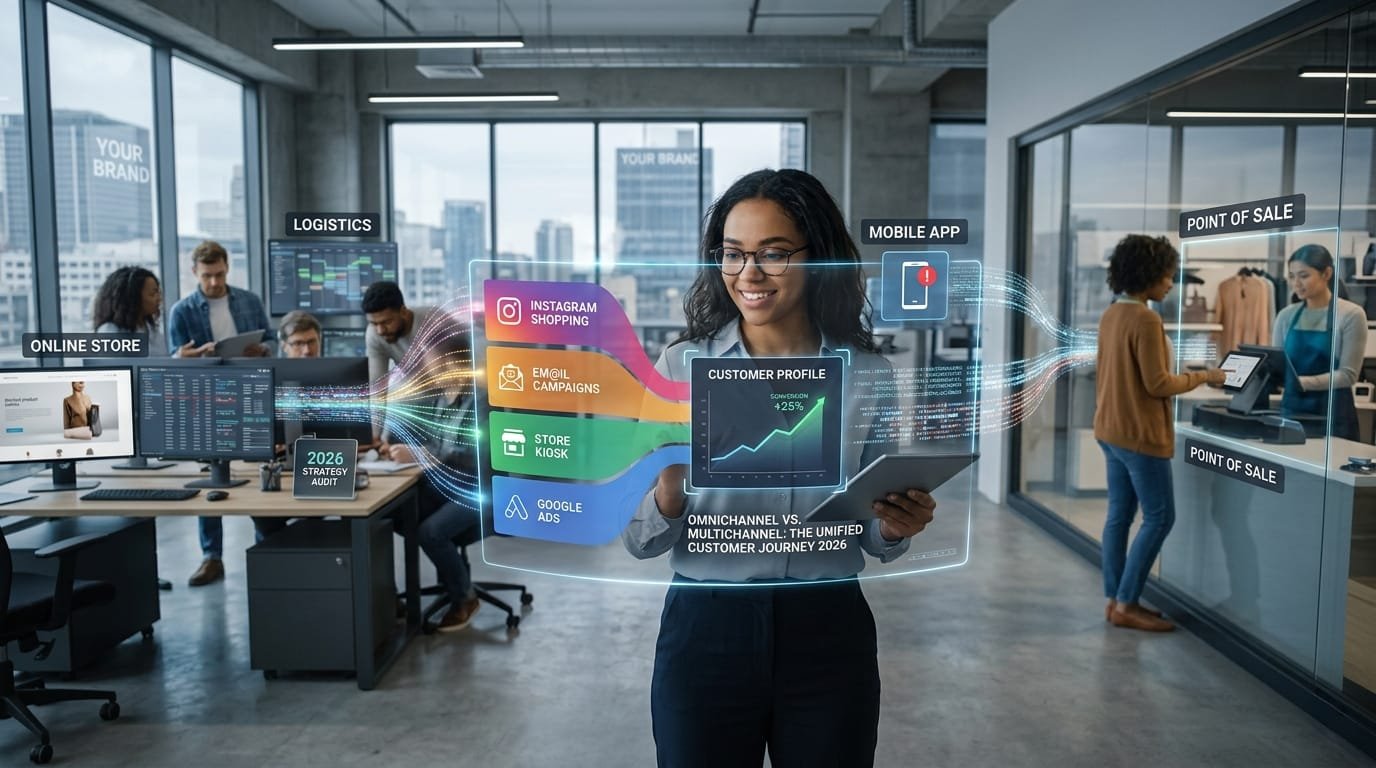
In the early days of digital marketing, “being everywhere” was the ultimate goal. If you had a website, a Facebook page, and a physical storefront, you were ahead of the curve. We called this Multichannel Marketing.
Fast forward to 2026, and “being everywhere” is no longer enough. In fact, if your presence across those channels isn’t perfectly synchronized, you aren’t just missing opportunities—you are actively frustrating your customers.
The modern consumer doesn’t see “channels.” They see a brand. If their experience on your Instagram mobile shop doesn’t match their experience with your email support or your retail kiosk, the relationship breaks. This is the fundamental difference between Multichannel and Omnichannel.
In this guide, we will break down why the shift to Omnichannel is the single most important pivot your business will make this year, and how a fragmented strategy is quietly draining your ROI.
Defining the Great Divide
To fix your strategy, you must first understand where you currently stand.
What is Multichannel Marketing?
Multichannel is a brand-centric approach. The goal is to cast the widest net possible. You operate on several platforms—social media, PPC, email, and print—but each channel operates as a silo.
- The Workflow: The social media team has their goals, the web team has theirs, and the retail staff has another.
- The Experience: A customer might see a discount code on Twitter, but when they try to use it on the website, it doesn’t work. Or, they buy a product online but find they cannot return it in-store because the systems don’t “talk” to each other.
What is Omnichannel Marketing?
Omnichannel is a customer-centric approach. It creates a seamless, unified experience across every touchpoint. It’s not about the number of channels; it’s about the integration between them.
The Workflow: All channels draw from a single “source of truth” (usually a unified CRM or Data Platform).
The Experience: A customer puts an item in their cart on their laptop. Later that day, they receive a personalized nudge on their phone. When they walk past your physical store, they receive a notification that the item in their cart is in stock and ready for them to try on.
Why Multichannel is Failing in 2026
In a hyper-competitive landscape, Multichannel marketing creates “frictional loss.” Here is how a fragmented strategy costs you money:
A. The Data Black Hole
In a Multichannel setup, data is trapped in silos. Your Google Ads team knows which keywords drive clicks, but they don’t know that those same customers are returning 50% of their orders through the mail. Because the data isn’t linked, you continue spending money to acquire “bad” customers.
B. Decreasing Customer Lifetime Value (CLV)
Customers in 2026 expect a “memory.” They expect you to remember what they bought last month, what their preferences are, and how they like to be contacted. When a customer has to repeat their issue to three different departments, their loyalty plummets.
C. Inefficient Ad Spend
If your channels aren’t talking, you are likely bidding against yourself or over-serving ads to people who have already purchased. Omnichannel allows for “suppression lists” across all platforms, ensuring your budget is only spent on moving the needle forward.
The Three Pillars of a Successful Omnichannel Strategy
If you want to transition from a fragmented Multichannel mess to a streamlined Omnichannel engine, you must focus on these three pillars:
Pillar 1: Centralized Data (The “Single Customer View”)
You cannot have an Omnichannel strategy without a unified database. In 2026, we use Customer Data Platforms (CDPs) to aggregate every interaction—clicks, views, purchases, and support tickets—into a single profile. This allows for “Contextual Marketing.”
Pillar 2: Channel Neutrality
Your organization must stop prioritizing one channel over another. The goal isn’t “Online Sales” or “In-Store Sales.” The goal is Revenue. When your internal teams stop competing for attribution, they begin to collaborate on the customer journey.
Pillar 3: Technology Integration
Your tech stack must be “API-first.” Your Shopify (e-commerce), HubSpot (CRM), Meta (Social), and Zendesk (Support) must be interconnected. If a customer complains on Twitter, your sales rep should see that alert inside the CRM before they make a follow-up call.
The ROI of the Pivot: By the Numbers
The shift to Omnichannel isn’t just about “feeling modern”; it is backed by hard data. Recent 2026 industry benchmarks show:
- Purchase Frequency: Customers who engage with an Omnichannel experience shop 250% more frequently than single-channel shoppers.
- Retention Rates: Businesses with strong Omnichannel engagement retain an average of 89% of their customers, compared to 33% for those with weak integration.
- Average Order Value (AOV): Omnichannel shoppers have a 13% higher AOV because the brand can provide more accurate, personalized cross-sell and up-sell recommendations.
How to Build Your Omnichannel Roadmap
Ready to stop the fragmentation? Here is the step-by-step approach we use with our clients:
- Map the Journey: Walk through your own buying process as a customer. Start on a mobile ad, move to the website, abandon a cart, and call support. Where does the “memory” of the brand break?
- Audit Your Tech Stack: Identify which of your tools are “islands.” If your email software doesn’t know what your POS (Point of Sale) system is doing, that’s your first bridge to build.
- Implement Real-Time Personalization: Use AI-driven tools to change website content based on the user’s previous social media interactions.
- Train Your Team: Ensure your customer service reps have access to the same data as your marketing team. Empowerment is the key to a seamless experience.
Conclusion: The Era of the Unified Brand
The “Multichannel” era was about volume—shouting from as many rooftops as possible. The “Omnichannel” era is about harmony—singing the same song, in the same key, across every platform.
As we move deeper into 2026, the gap between the brands that “know” their customers and the brands that just “target” them will widen. Fragmented marketing is an expensive relic of the past. Integration is the future.
Is your marketing strategy a collection of silos or a unified engine? At TheYaman, we specialize in breaking down digital walls and building high-performance Omnichannel ecosystems. Schedule your free Strategy Audit today and let’s turn your fragments into a roadmap for growth.