
Table of Contents
Normal SEO vs AI SEO Key Difference change sweeps through online spaces now. Two decades of routine have shaped how sites climbed rankings – hunt down popular terms, tuck them into page tags, gather solid links from outside sources, then see visits rise slowly.
Search isn’t what it used to be. Now, finding info often means getting replies built by artificial intelligence – seen in tools like Google AI Overviews, ChatGPT Search, or Perplexity. Instead of clicking through rows of blue links, people pose detailed questions, waiting only seconds for clear summaries served up instantly. What once meant digging now feels more like asking and receiving.
Here we stand, at a turning point shaped by tech shifts: regular SEO against AI-driven SEO – spot the gap. Run a big website or grow a small blog, it does not matter; sticking only to old-school tactics pulls you straight into online obscurity. Picture this – standard methods now just get you through the door, nothing more. Machines learn faster than ever, so your plan must shift without delay. What once worked fades, replaced by smarter systems watching every move. Survival means evolving quietly but surely beneath the surface.
Defining the Baseline: Normal SEO vs AI SEO Key Difference in Focus
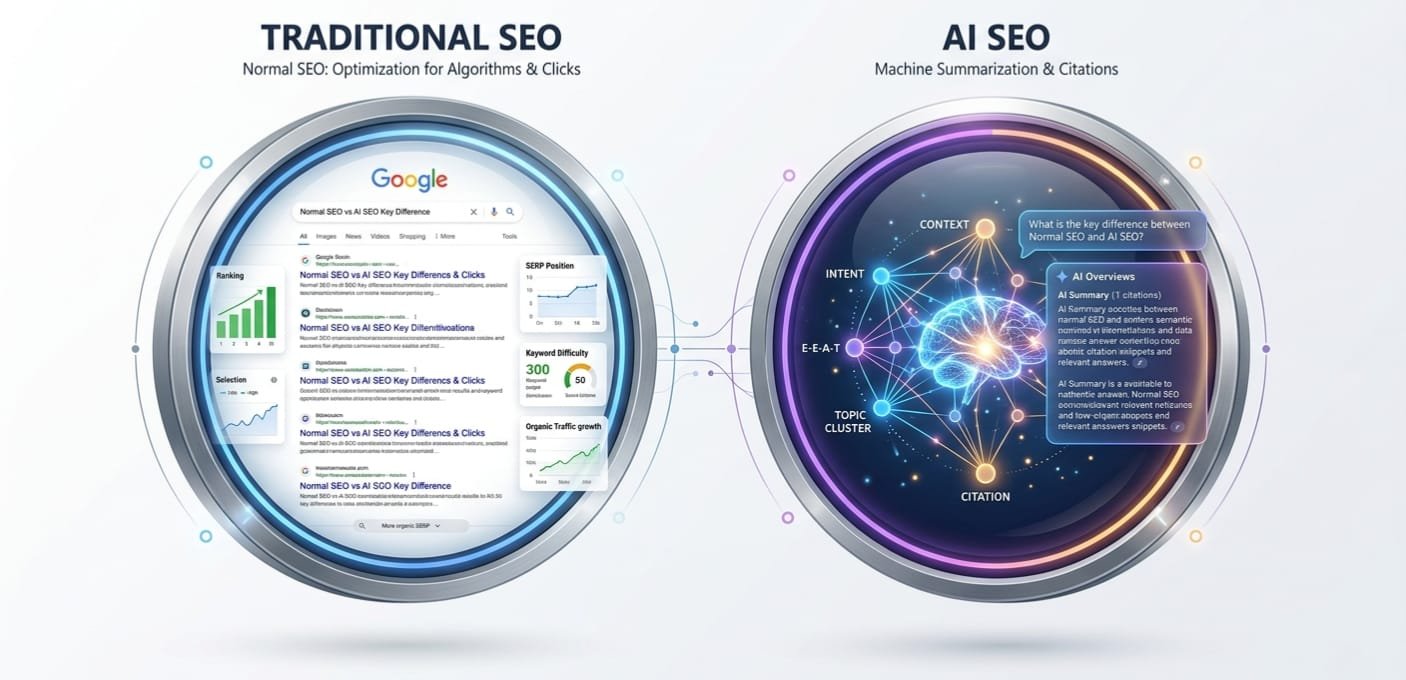
To understand where search marketing is going, we first have to understand where it has been. Traditional optimization and artificial intelligence optimization are not competing hobbies—they are two entirely different operating systems for the web.
Traditional SEO: Optimizing for Algorithms and Clicks
One step at a time, old-school SEO works by lining up what people type with certain online spots. Getting near the top spot matters most because more clicks usually follow when you’re right there. Page after page, it’s about fitting words together so machines notice.
A webpage becomes a straight story under regular SEO. Keywords go inside certain spots of the HTML – for instance, the title, headings, or descriptions for images – helping bots sort pages fast. What counts? Where you rank for those words, how often people see your link, also traffic arriving directly from search results.
AI SEO: Optimizing for Machine Summarization and Conversational Citations
AI search optimization flips the script. Instead of asking, “How do I rank for this keyword?” it asks, “How can an artificial intelligence model understand, trust, and quote my content?”
Instead of reading page by page, big language systems break down words into pieces, then pull out what they actually mean. Inside these setups, success leans more on shaping replies for answer engines – also tweaking how generative tools respond. Getting picked isn’t about grabbing attention anymore – it’s about being named directly within the AI’s own wrap-up.
4 Technical Distinctions Marking the Normal SEO vs AI SEO Key Difference
When you look beneath the hood, the operational contrast between traditional execution and AI-first methodology comes down to how data is structured, read, and retrieved.
1. Single Keywords vs. Semantic Entity Networks
Most old-school methods bank on matching keywords to a tee. Picture someone hunting for top-tier business accounting tools – they’d scatter that precise line all through the page like breadcrumbs. Precision matters here, not paraphrasing.
Out there on the web, AI systems use NLP to map connections like a network of dots and lines. These models scan not just words but what they mean together. A single page won’t cut it unless it weaves in surrounding ideas. Think about how one concept pulls others along – tools people rely on, names experts recognize, threads that tie knowledge together. Depth shows up when links between subjects feel lived-in, not forced. For machines reading closely, gaps stand out more than filler. When topics breathe across subtopics, authority becomes visible without shouting.
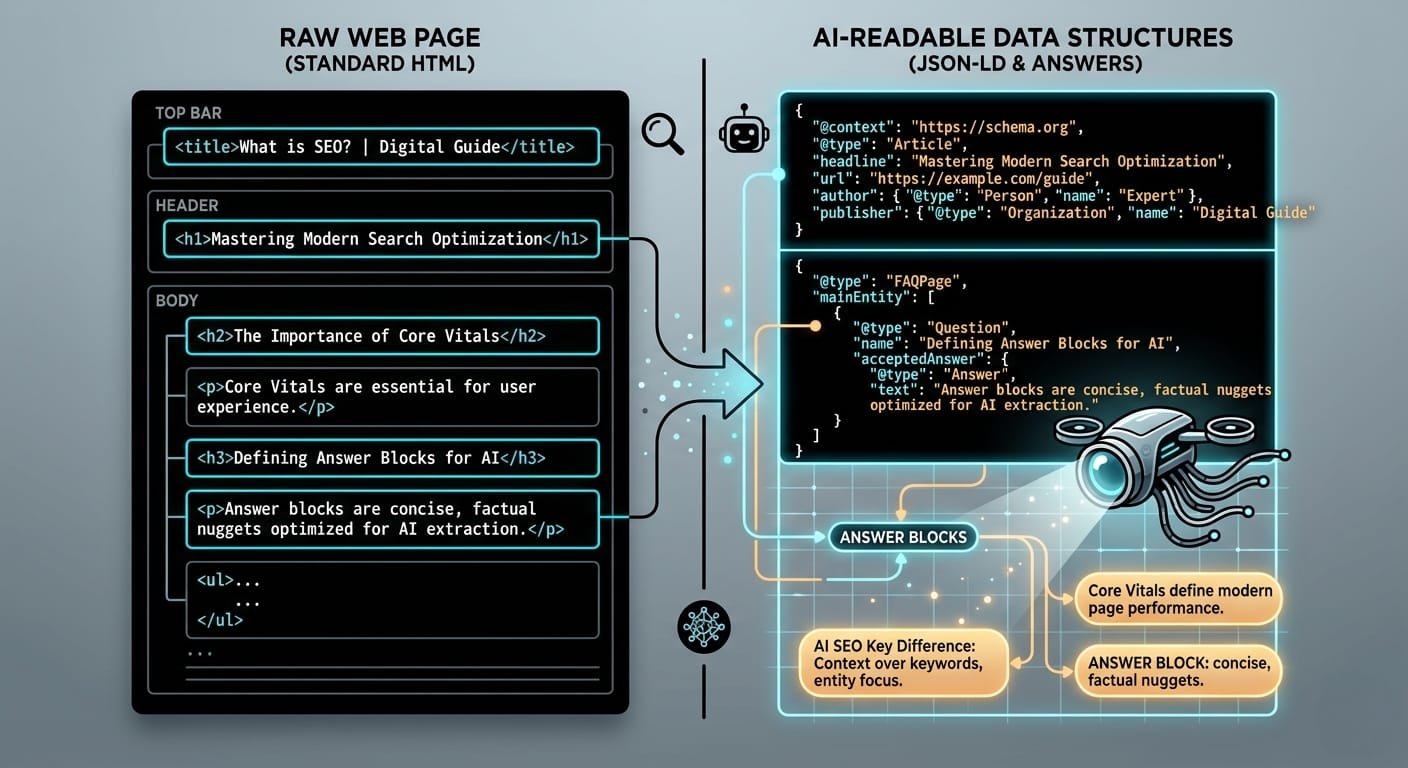
2. Standard HTML Formatting vs. Machine-Extractable Answer Nuggets
Long blocks of text get split by headings like h2 or h3 in classic publishing, just to help people read easier.
Headers give AI systems exact signposts. Right below those subheaders, smart machines hunt – specifically – for tight forty-word replies. When software fails to pull out one complete thought fast? Your page gets passed over. Rivals earn the mention. Context-free clarity wins every time.
3. Basic Crawlability vs. Heavy Schema Infrastructure
A well-kept robots.txt file comes first, along with a current XML sitemap sitting quietly behind the scenes. Quick loading times matter just as much – they always have. Each piece stands firm, refusing to bend under changing trends. Without them, nothing else holds.
Still, getting AI to work well means building strong data systems using JSON-LD. When pages use clean labels – like Article, FAQPage, Dataset, plus proof authors are trustworthy – they stand out for inclusion in AI summaries. Think of schema as a live interpreter linking your site straight to how large models read information.
4. Traffic Volume vs. High-Converting Conversational Leads
What really sets things apart is how people are clicking now. Because of all the AI tools around, fewer folks are tapping on links for simple questions.
Still, numbers tell a different story now. Not long ago, regular search traffic led to steady but modest results. Yet people arriving via AI suggestions often take action much faster. These aren’t casual browsers – they’ve been guided by smart tools step by step. A tap on a source mentioned by a bot means deeper interest. By the time they land on your page, hesitation tends to be gone.
Normal SEO vs AI SEO Key Difference Comparison Matrix
To visualize how these two approaches operate concurrently in a modern marketing strategy, consider their primary performance pillars side-by-side:
| Optimization Pillar | Traditional SEO Strategy | AI SEO Strategy |
|---|---|---|
|
Primary Target |
Traditional Search Index Crawlers |
Large Language Models & Synthesizers |
|
Core Metric |
SERP Ranking Position & CTR |
LLM Citations, Brand Mentions & Share of Model |
|
Content Structure |
Linear articles with keyword variations |
Modular content with direct answer blocks |
|
Discovery Mechanism |
User types queries into a search bar |
User interacts with a conversational prompt |
|
Technical Focus |
URL structure, core vitals, links |
Extensive Schema markup, entity validation |
Integrating Both Approaches Into Your Current Content Workflow
Most links showing up in Google’s AI answers are already winning regular search spots. That means old-school SEO still matters a lot. Winning trust the usual way opens doors to being seen by AI systems. Tossing out proven methods won’t help much. Authority built before stays useful now. What worked earlier keeps shaping what gets noticed today.
Start with old-school methods to build trust step by step. After that, shape everything using AI-driven layouts so machines understand without confusion.
Step 1: Front-Load Your Answers
Start right off knowing the key point always comes first. Put the main answer up top, just after the title. That way people see it fast. What follows can go into details, like examples or background stuff. Experts often add explanations later on. Tables show data clearly when needed. Case studies bring real situations forward. Never hold back the big idea to tease interest. Clarity matters more than drama here. Information works best when it lands without delay.
Step 2: Build Content for Structural Extraction
Presenting information? Skip lengthy blocks of text. Instead, break things down using clear Markdown tables. Lists help too – simple bullets organize ideas fast. Step-by-step flows guide attention naturally. Search bots pull structured snippets effortlessly. They drop these pieces straight into preview boxes online. Clean layout means easier pickup by automated scanners. Formatting shapes how widely it spreads.
Step 3: Double Down on True E-E-A-T
Most online stuff feels the same now, churned out by machines. Since large models learn from what’s already online, repeating common knowledge gets you nowhere. Standing out means adding something only real people can make. Try actual project breakdowns done by your team. Toss in images captured during live tests. Include thoughts from seasoned professionals who’ve been there. Share takes that challenge standard views. Being quoted starts with saying things others won’t.
Reality hits hard in 2026. Standing at the top of search results isn’t enough anymore. Real presence goes to those brands consistently backed by systems that analyze, judge, then promote them. Being seen now depends less on placement – more on proof.